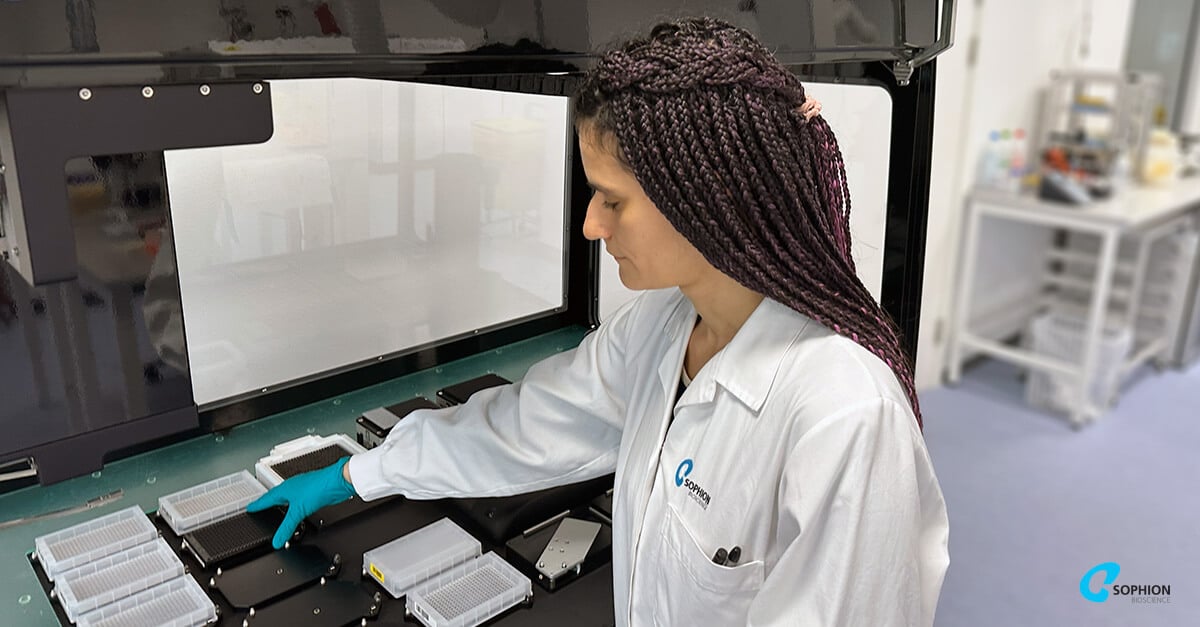
Research grant sparks breakthroughs in spider venom studies and Kv7 ion channel research
Dr. Dani Rojas-Azofeifa’ recent research grant at Sophion’s Copenhagen labs marks a novel chapter in the study of spider venoms and their use in diseases like epilepsy. Now back in the lab of Prof. Glenn King, University of Queensland, Dr. Rojas-Azofeifa shares her findings and reflects on the unique challenges and insights gained during her research grant experience.
Q: How did the results of your study align with your original aims of understanding spider venoms in Kv7.2/7.3 pharmacology?
This work validated the original hypothesis that spider venoms contain modulators of Kv7.2/7.3 channels, highlighting the pharmacological diversity present in these venoms. In collaboration with Dr. Kim Boddum (Sophion), I successfully developed and optimized robust protocols for the Sophion Qube platform for Kv7.2/7.3 assays, later expanding to other Kv7 subtypes (Kv7.1–7.5) and Kv11.1, for future selectivity and off-target profiling using the QPatch. With these optimized methods, I screened hundreds of arachnid venoms and identified at least ten venoms with activity worth pursuing further. In collaboration with Dr. Melissa Bernard Valle (DTU), I separated the venoms into their components and then analyzed their efficacy and specificity.
Q: Were there any new insights or unexpected findings from the experiments conducted using Sophion’s Qube automated patch clamp?
During the screening of 220 spider venoms, I identified at least ten venoms that produced clear and reproducible modulation of Kv7.2/7.3 channels, highlighting strong candidates for follow-up work. It was particularly valuable to use the Qube, as it allowed me to test a very large number of venoms while using only minimal amounts of material, and later to evaluate individual venom components, which can number more than 50 per venom, in an efficient and high-throughput manner.
Q: What key takeaways or techniques from this experience will you bring back to the King lab at IMB, University of Queensland?
I gained a lot of practical experience using automated patch clamp systems and electrophysiology in general, from setting up and improving the assays, to fixing issues and making sure the data were reliable. I also became much more confident in analyzing large datasets and identifying strong hits. This opportunity helped me understand how to scale up electrophysiology experiments and how to connect the venom work with the functional testing in a smooth and efficient way. These skills will help me contribute to improving our future screening projects and support students and colleagues working on ion channel research in the lab.
Q: How do you see these findings impacting the broader field of spider venoms, Kv7 ion channels, and related diseases like epilepsy?
Finding several venoms that affect Kv7.2/7.3 channels supports the idea that venoms are a great, and still largely unexploited, source of new ion channel modulators. On top of that, the protocols and datasets developed during this project will be useful for both neuroscience and cardiovascular research, since Kv7 channels are involved in both brain and heart function.
Q: Considering the results, are there new directions or hypotheses you are interested in pursuing within the realm of ion channel research?
Building on these results, the next step is to identify the specific venom peptides responsible for the activity we observed and to understand how they work. It will be especially useful to see how they affect different Kv7 subtypes, including Kv7.2, Kv7.3, and the combinations they form, as this can reveal if they can have an effect on specific mutations of these ion channels. I would also like to test the most promising peptides in neuronal models that mimic the mutations seen in developmental and epileptic encephalopathies. Overall, this project is just the beginning, and I’m excited to keep developing the best hits into more refined peptide candidates, hopefully working together with students and collaborators as the project progresses.
Q: What do you envision as the next steps in translating these findings into potential therapeutic strategies for epilepsy and cardiovascular disease?
The next steps will focus on turning our findings into potential therapies. We will first validate the most promising venom-derived peptides to see how well they work and select the safer ones. These lead peptides will be tested in disease-relevant models, including brain organoids derived from epilepsy patients, which are grown in the lab to mimic human brain tissue. This will help us see if the peptides can correct hyperexcitability. At the same time, we will check for effects on heart cells to ensure safety.
Ready to move your research forward? Explore Sophion research grants and make an application for your own research with Sophion.